| Event type: | Meeting |
| Date: | 27th January 2026 |
| Time: | 11:00 am |
| Booking: | Note that booking is required. |
'WHY SNAILS MIGHT HOLD SOME ANSWERS TO AGE-RELATED MEMORY LOSS'
by Professor Mark Yeoman (University of Brighton and University of Sussex)
About the speaker
Prof Yeoman studied for a degree in pharmacology at the University of Southampton and it is there that he became interested in how the brain functions. This interest took him to the University of Aberdeen where for his PhD he explored how the effects of pressure experienced by deep sea divers affected brain function. He then left Aberdeen and headed south to the University of Sussex and was introduced to the humble pond snail which became the focus on his research for many years.
During his time at Sussex Prof Yeoman has worked on several projects. The first explored how circuits that drive rhythmical behaviours, like chewing, walking, and breathing, can be chemically modified to generate many different outputs depending on our needs. The second project tried to unravel the complexity of cell to cell signalling by asking why single nerve cells contain very many different chemical signalling molecules.
After nine years at Sussex, Prof Yeoman moved to the University of Brighton where he started to utilise the pond snail to understand the basic biology of the natural ageing process. The more he explored how the CNS aged in the pond snail, the more he realised that at a fundamental level these processes were shared between snails and mammals. Working with colleagues at the University of Sussex and the University of Calgary, he has started to explore how ageing affects the ability of the snail to learn and remember, and it is this work that he will focus on for his presentation.
How to attend
Pre-registration is essential but is free for any u3a member. You can register here.
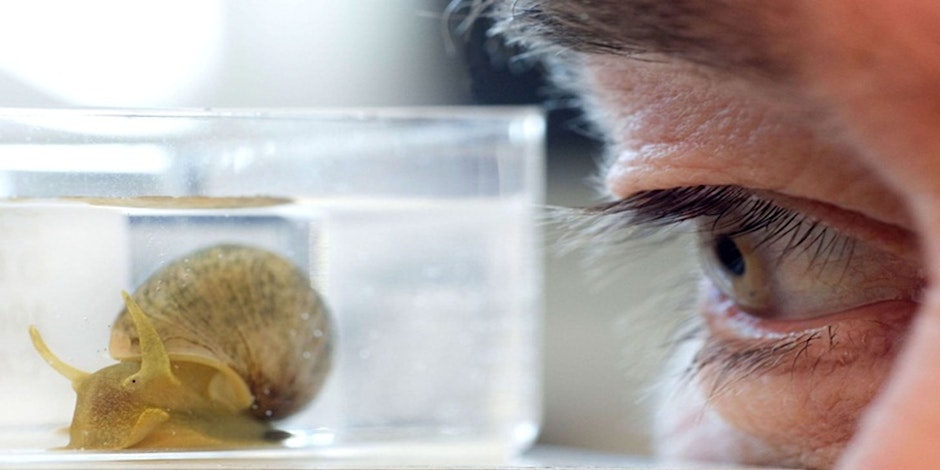
Professor Mark Yeoman will explore the role that molluscs have played in understanding how we learn and remember, and how they can be used for studying age-related memory loss.